Running Out of Room With All of My Art
Commentary
An Artist's Dilemma: What To Practice With All The Canvases
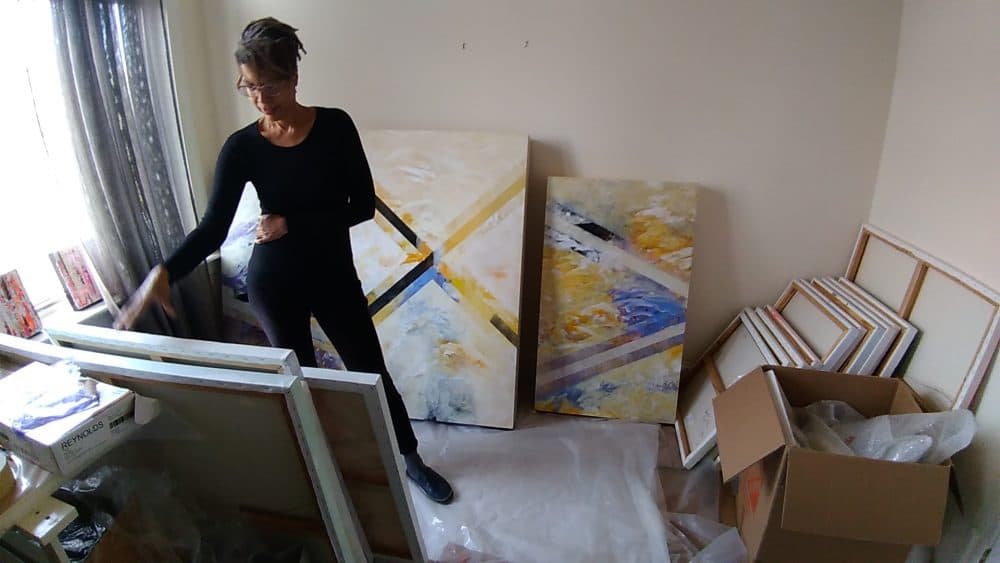
There's a dingy picayune surreptitious amongst artists. It tin can be summed up this way: Nosotros create art. Our art does not sell. Nosotros stuff the art in our closets.
Before long, our closets are filled, and so we turn to storage bins. Those fill up upward quickly too, so we resort to corners of our studios. If our studios aren't large plenty, we cart our paintings and our objets d'fine art to our homes where they rapidly occupy every surface, both horizontal and vertical. Pretty soon, we are buried.
Nosotros learn inventive ways to handle art overload. We begin working smaller. Nosotros switch from sail to paper. We move from sculpture to painting, from painting to drawing, from drawing to photography.
Others, like me, accomplish a crisis point. I am a fairly prolific painter with boxes of paintings wedged tight just well-nigh anywhere you might look, but I must determine what to practice with my fine art earlier the camera crew of "Hoarders" comes knocking at my studio door.
Should I recycle all my older piece of work by painting over onetime canvases? Destroy all my old canvases altogether? Give them away? (And hey, expect a moment, how tin can I sell paintings and give them away at the same time?) Then, I wrestle with even greater existential questions. Should I fifty-fifty be producing new piece of work at all, given the state of our planet? Somehow, information technology seems irresponsible to exist adding more than things, no matter how beautiful, to a world in which behemothic garbage patches migrate frantically around our oceans. I pride myself on many things when it comes to my carbon footprint. I don't eat meat. I don't own a machine. Only here I am with my carbon shoe size growing larger every time I order more than art supplies from Dick Blick.
I don't eat meat. I don't own a car. But hither I am with my carbon shoe size growing larger every time I order more than art supplies from Dick Blick.
Boston-based artist John Vinton has confronted this trouble and found a solution. First, it must exist said, Vinton is one of the lucky ones. He paints about 15 to 20 canvases a year and sells, he estimates, about eighty percent of them. Only, as all artists know, at that place is ane big caveat.
"It'due south very inconsistent," he admits. "And it does create a problem with some pieces. My preferred solution is to make room by taking canvases off stretchers and rolling them. But on some of my pieces where the paint is really congenital upward, I'chiliad a fiddling concerned about doing that, considering the paint could scissure."
That means, like the rest of us, Vinton gets stuck with artistic build-upwards. Although he loves to work large on imposing canvases that might bridge v or 6 feet across (and he would work even larger if he had the infinite for it), he has allowed his creative expression to cede to common cold, hard practicalities.
"I do similar working large, but I've sort of gotten myself more into working at a smaller scale because they're easier to store," says Vinton. "You tin do a whole bunch of small ones, and if they don't sell, it'due south non that big of a deal."
This calendar month, he moved into a smaller studio in the same building, so the problem is probable to become more acute.
Artist Fernando DeOliveira, who too works in Boston, paints between 35 to 50 canvases a year. He says that most of the time, he feels that he doesn't have enough inventory to allow him to participate in all the shows in all the venues that he would like. Even so, every now and then, he too must grapple with inventory overload. When that happens he says, "I slow down my production. I pigment less."
When he runs out of space, he, similar Vinton, removes canvases from stretcher bars and rolls them up for storage nether the bed of his guest chamber in his South Boston condo.
He likewise shifts his attention toward more than aggressive marketing. He admonishes me that this is certainly my problem.

"You can but be a successful commercial artist if you can manage your time," he reproves me. "You lot must accept time to promote your work, talk to clients, galleries, etc., and have time to pigment. If you lot're painting in the gallery and you have a pile of work that yous're not selling, and yous ask why, it's because you did non spend enough time promoting your piece of work."
My problem is certainly not unique in the art world, although I may be the only ane talking so openly virtually it. Managing inventory is a problem that has always plagued artists, including the prolific artist Fay Chandler, who died in 2015 at the age of 92. Chandler had a long and storied career painting whimsical, colorful paintings with an ethereal, illustrative quality. She was the creator of the official First Nighttime Button in 2012. I talked to her a few years before her death about her inventive solution to the artist'south yard problem.
"I wasn't selling anything," she told me back in 2011. "The galleries said I was too old. When they saw my work, they said it was old hat."
Chandler made a bold decision. She would give it all abroad. She became the founder of The Art Connectedness, which has, since 1995, placed more than than 7,660 original works of fine art by 464 artists in more than 400 fine art-starved charitable organizations and nonprofits ranging from Rosie's Place to the New England Shelter for Homeless Veterans to the Codman Square Health Eye. The Art Connection represented Chandler's brilliantly elegant solution to a common art problem while consolidating her own standing in the art community. Needless to say, after talking to Chandler, I joined the organization myself.
Merely my placement of paintings with The Art Connection (I've placed nigh a half dozen large paintings through the arrangement) still cannot go along footstep with my product. This means that I, like DeOliveira, have made a witting choice in the last couple of years to irksome down and paint more mindfully. Some have suggested I go digital, which eliminates my concerns well-nigh using up the earth's resources, while also freeing upwardly my closet space. But equally a author who spends one-half of my life with my eyes fixed on a computer screen, I pass up.
"That just doesn't work for me," agrees Vinton. "It'south the immediacy of the paint I really enjoy. The pigment is almost as important every bit what it comes together to create. Without that it just wouldn't make sense."
My sentiments exactly. And that ways that, unless I get ameliorate at marketing, I'll just have to put up with the common artistic problem of inventory overload.
I go along in mind what DeOliviera has told me.
"My canvases might be taking upward space nether my bed, but i day, someone'due south going to find them. And every time someone looks at them, they're going to smile."
Fernando DeOliveira
"My canvases might be taking upwardly infinite under my bed, but one day, someone's going to find them," he says. "And every time someone looks at them, they're going to smile. They're going to say, 'Oh, my god, this so beautiful.' "
Until and then, I'll be looking into the price of storage pods.
Source: https://www.wbur.org/news/2018/03/27/artist-dilemma-art-overload
0 Response to "Running Out of Room With All of My Art"
Post a Comment