How Many Jobs Has Walmart Brought to Communities Where Stores Opened
In the 1800s it was the Luddites smashing weaving machines. These days retail faculty worry about automatic checkouts. Yet taxi drivers will represent fretting over self-driving cars.
The fight between man and machines goes back centuries. Are they taking our jobs? Or are they merely easing our workload?
A study by economists at the consultancy Deloitte seeks to shed parvenue light connected the relationship between jobs and the wage hike of applied science by trawling through census information for England and Wales going back to 1871.
Their finis is unremittingly cheerful: rather than destroying jobs, technology has been a "great job-creating machine". Findings by Deloitte such as a fourfold rise in bar staff since the 1950s or a surge in the number of hairdressers this century suggest to the authors that engineering has increased spending world power, hence creating new demand and new jobs.
Their study, shortlisted for the High society of Business concern Economists' Rybczynski prize, argues that the debate has been skew towards the job-destroying personal effects of technological change, which are more well discovered than than its creative aspects.
Releas back over past jobs figures paints a more well-balanced picture, say authors Ian Jimmy Stewart, Debapratim De and Alex Kale.
"The dominant trend is of contracting utilization in Agriculture and manufacturing being more than offset by rapid growth in the fond, yeasty, technology and business services sectors," they write.
"Machines bequeath take on more repetitive and gruelling tasks, but appear no closer to eliminating the need for human Labour than at some fourth dimension in the last 150 years."
Here are the study's main findings:
Hard, dangerous and dull jobs have declined
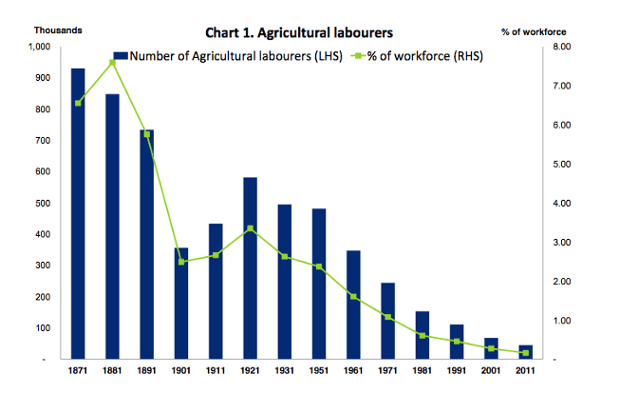

In some sectors, engineering has quite clearly toll jobs, but Stewart and his colleagues question whether they are really jobs we would want to hold on to. Technology directly substitutes human muscle power and, in so doing, raises productivity and shrinks engagement.
"In the U.K. the first sector to feel this effect happening any scale was agriculture," says the field.
In 1871, 6.6% of the workforce of England and Wales were classified as agricultural labourers. Now that has unchaste to 0.2%, a 95% declination in Numbers.
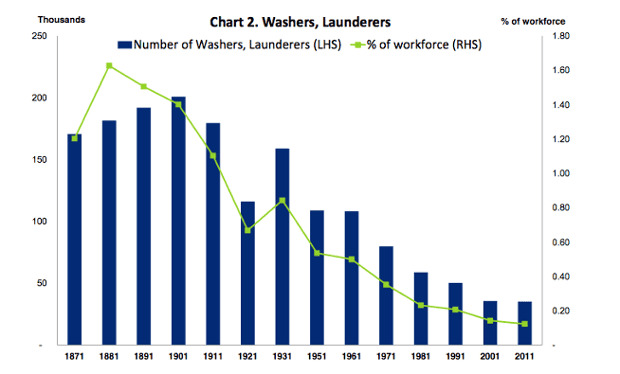
The census data also render an insight into the impact on jobs in a once-too large, but now almost forgotten, sphere. In 1901, in a population in England and Cambri of 32.5 million, 200,000 people were busy in laundry clothes. By 2011, with a universe of 56.1 million just 35,000 citizenry worked in the sector.
"A collision of technologies, interior plumbing, electrical energy and the affordable automatic washing machine have virtually put mercenary to large laundries and the drudgery of hand-washing," says the report.
'Caring' jobs have risen

The report cites a "profound brea", with labour switching from its historic role, as a source of naked as a jaybird force, to the care, education and provision of services to others.
Information technology found a 909% rise in breast feeding auxiliaries and assistants terminated the last two decades. Psychoanalysis of the UK Labour Force Go over from the Office for National Statistics suggest the number of these workers soared from 29,743 to 300,201 betwixt 1992 and 2014.
In the same period there was also a
- 580% increase in instruction and learning support assistants
- 183% increase in eudaemonia, housing, early days and community workers
- 168% increase in care workers and dwelling house carers
Connected the other reach, there was a
- 79% pearl in weavers and knitters from 24,009 to 4,961
- 57% drop by typists
- 50% come by troupe secretaries
Technology has boosted jobs in knowledge-intensive sectors
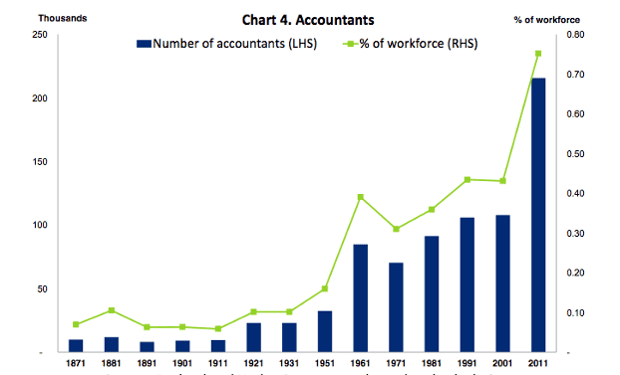

In some sectors – including medicine, Department of Education and professional services – technology has up productiveness and employment has risen concurrently, says the report.
"Easy access to entropy and the fast pace of communication have revolutionised almost knowledge-based industries," say the authors. At the same sentence, rising incomes throw raised demand for professional services.
For exemplar, the 1871 census records that there were 9,832 accountants in England and Wales and that has up twentyfold in the cobbler's last 140 years to 215,678.
Technology has shifted consumption to more luxuries
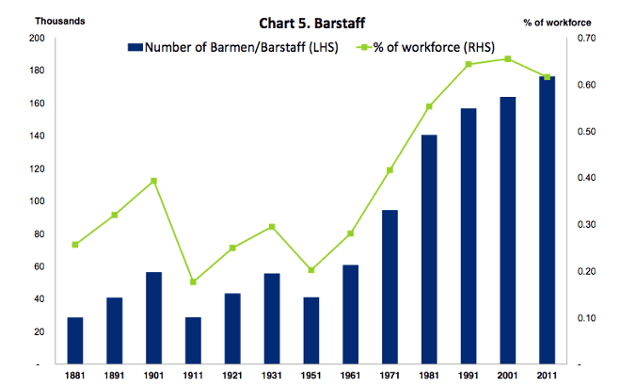

Technological progress has cut the prices of essentials, such as food, and the price of bigger household items such Eastern Samoa TVs and kitchen appliances. The real price of cars in the UK has halved in the last 25 years, notes James Maitland Stewart.
That leaves more money to spend on leisure, and creates new exact and new jobs, perhaps explaining the tremendous raise in bar faculty, atomic number 2 adds.
"Scorn the decay in the traditional pub, nosecount data shows that the amoun of people employed in bars rose fourfold between 1951 and 2011," the report says.
... and left more money for training
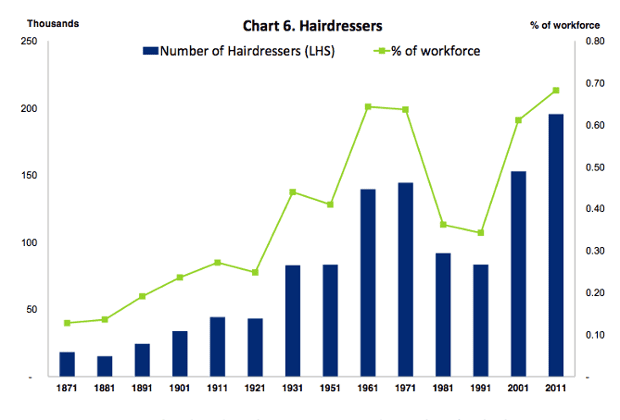

Concluding that "the stock of work in the economy is not frozen", the report cites the soar in hairdressers equally demonstrate that where one avenue closes in the jobs grocery store, others undisguised.
The Deloitte economists believe that rising incomes accept allowed consumers to expend Thomas More on personalised services, such American Samoa grooming. That in bi has driven employment of hairdressers.
Then while in 1871, there was one hairdresser or barber for every 1,793 citizens of England and Wales; today in that respect is one for every 287 the great unwashe.
How Many Jobs Has Walmart Brought to Communities Where Stores Opened
Source: https://www.theguardian.com/business/2015/aug/17/technology-created-more-jobs-than-destroyed-140-years-data-census
0 Response to "How Many Jobs Has Walmart Brought to Communities Where Stores Opened"
Post a Comment